Puddle Pour Mastery: Essential Fluid Art Guide
Mastering Puddle Pour: The Ultimate Guide to Fluid Art
Understanding Puddle Pour Art Technique
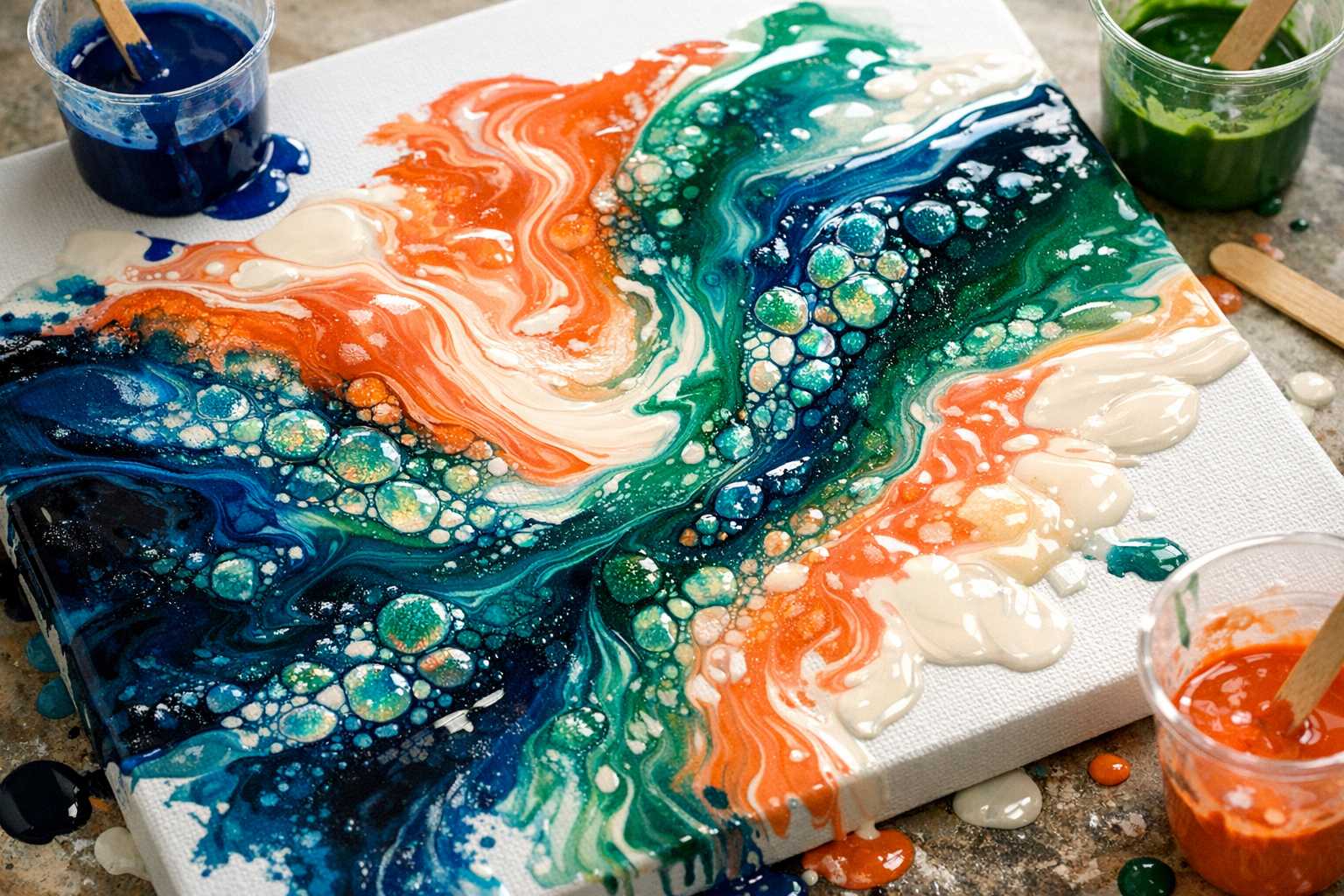
Puddle pour is an excellent starting point for anyone looking to get into fluid art. This unique technique involves pouring paint directly onto a canvas, creating captivating puddles. Tilting the canvas then seamlessly introduces the magic, allowing the vibrant colors to flow and blend organically.
Witnessing the dance of colors is pure magic - they create unexpected, mesmerizing patterns that can be bewitching even for seasoned artists.
Puddle Pour Art: Why It's a Preferred Choice
I hold a special place in my heart for puddle pour considering how forgiving it is. Unlike many fluid art techniques, it doesn't require precise proportions or complex mixtures. Your outcome will always be appealing. Even your "mistakes" can metamorphize into unique, beautiful aspects within your art piece.
Moreover, it is quite economical on paint when compared to methods like dirty pours. Your wallet will certainly appreciate this!
Essential Materials for Successful Puddle Pour Art
Artistic Paints and Pouring Mediums
For standout results, opt for top-quality acrylic paints. Fluid acrylics or heavy body acrylics thinned down with a medium can make a difference.
Your choice of pouring medium is pivotal in achieving your desired end product. Floetrol is budget-friendly and works perfectly. You can alternatively opt for specialized pouring mediums like Liquitex or Golden.
Canvases and Art Surfaces
For starters, pre-stretched canvases are quite convenient and are readily usable.
Wooden panels too, serve wonderfully. They have a solid structure and won't warp as a canvas might due to wet paint.
Essential Tools for Puddle Pour Art
The key here is simplicity. The only tools you'll need are: - Plastic cups for paint mixing - Wooden stir sticks - A torch or heat gun to annihilate bubbles - Gloves to protect your hands - Drop cloths for expedient cleanup
A Step-By-Step Manual to Puddle Pour Technique
Preparing Your Paint
Mix your paint with the pouring medium in a roughly 1:1 ratio. The mixture should have a consistency reminiscent of warm honey.
Add some drops of silicone oil for cell formation. But remember, even without cells, puddle pouring can create breathtaking art pieces.
Commencing Your Puddle Pour
Commence by pouring the first color directly onto the canvas, making it roughly the size of a dinner plate.
Introduce the second color next to the first, only touching, not overlapping.
Continue adding colors either cyclically or linearly. Trust your instincts here!
Tilt: The Moment of Magic
Now comes the exciting part. Gently lift one side of your canvas.
Observe as the cascade of colors flow and combine. You can manipulate the tilt to guide the paint to your desired areas.
Avoid overthinking; let the paint do the work!
Achieving Amazing Results: Valuable Tips
Choosing the Right Colors
Select colors that merge perfectly. Reflect on the color wheel for guidance.
Blue and green hues evoke oceanic vibes, while warmer colors like red and oranges channel an energetic aura.
Try to incorporate at least one neutral color, like white or black, to balance the composition.
The Essence of Timing
Strike a balance between speed and efficiency. Blues and greens create ocean vibes. Paint begins to form a skin as it dries.
If the paint seems too thick, introduce more medium. Conversely, if it's too thin, incorporate more paint.
Temperature Plays a Role
Warm paint tends to flow better than cold paint. Endeavor to maintain your paints at room temperature.
Cool art studios can make paint sluggishly flow. A small heater can rectify this.
Mistakes to Sidestep
Overmixing Your Colors
In the case of puddle pours, moderation is key. Cease tilting at a point where you find the pattern appealing.
Overmixing can muddy your color scheme.
Dispensing Too Much Paint
Start with small amounts of paint; you don't need a lot.
Refrain from the "more is better" mindset, as you can always add more paint, but you can't take it back.
Ignoring the Canvas Edges
Discarded paint is wasted. Ensure you cover the canvas edges.
Troubleshooting Your Puddle Pours
When the Paint Doesn't Flow
If the paint won't flow, it's probably too thick. Gradually add more medium.
Cold paint could also be the issue; warming it gently may help.
If Your Colors Appear Muddy
If your colors appear muddy, tilt less next time or select colors from a similar color family.
Lack of Cell Formation
Even though cells aren't mandatorily needed to create beautiful art, if you desire them, incorporate some silicone oil.
Different paint brands may produce different cell formats. Feel free to explore different brand combinations.
Advanced Puddle Pour Techniques
Layered Puddle Technique
Add depth to your piece by employing multiple layers of puddles. After pouring the first layer, let it settle for around 30 minutes. Then, pour smaller puddles atop it. This method results in incredibly multi-dimensional pieces.
Hybrid Ring Pour
Blend puddle pour and ring pour techniques by pouring concentric circles within the puddles. This generates distinct, attention-grabbing patterns within the natural shapes.
Negative Space Puddles
Leave some spaces empty between the puddles. Tilting will then fill these spaces, creating exquisite blends.
Preserving and Enhancing Your Artwork
Give Your Artwork Time to Dry
Be patient, as puddle pour paintings can take 24-48 hours to dry completely.
Heavily painted areas may take longer. Refrain from rushing this process.
Varnishing for Durability
Always varnish your final piece to protect it from UV rays and dust accumulation.
For best results, use a superior-quality acrylic varnish and apply it in thin, even layers.
Evolve Your Fluid Art Practice
Venture into puddle pour art while continually exploring other techniques. The skills you acquire, such as understanding color theory and paint consistency, are applicable across all fluid art forms.
Final Words on Mastering Puddle Pour
Creating fluid art through puddle pouring is highly rewarding. Each piece is distinctive and replicating it exactly becomes improbable.
Revel in the unpredictability of it. It's in these moments of surprise where the genuine magic lies.
Remember, there are no slip-ups in fluid art, only exciting discoveries that await unveiling.
Don't hesitate to begin your puddle pour journey today. The creation of your first masterpiece is just a tilt away!