Scientific Plant Illustration: Botanical Art Fundamentals
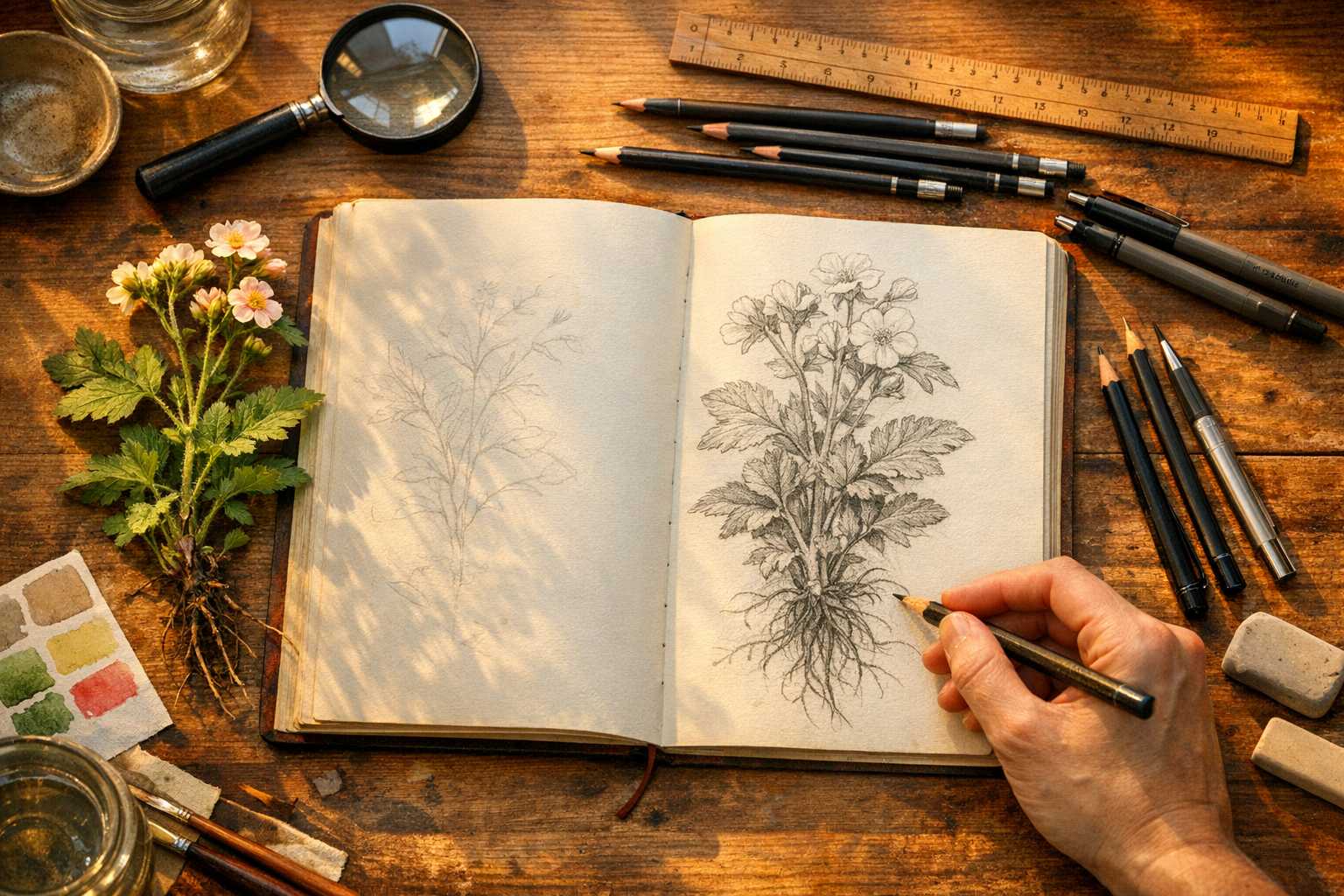
Botanical Art Fundamentals: A Look into the World of Scientific Plant Illustration
Have you ever wondered about the origin of the exquisite plant drawings found in field guides? The intricate blend of science and art results in these aesthetic marvels popularly known as scientific plant illustrations. In this fascinating realm, artistry meets scientific precision.
Join me on an insightful journey into the heart of botanical art. Get ready to uncover techniques that have been in play for centuries and have assisted scientists in documenting a multitude of plant species worldwide.
Why Scientific Plant Illustrations Stand Out
Differing from ordinary floral sketches, scientific plant illustrations are meticulous artworks where every stroke has a meaning, and each detail mirrors scientific preciseness.
The role of botanical artists is akin to detectives, investigating miniscule details often overlooked by the untrained eye. Their mission is to produce images that aid in identifying plant species accurately.
Such illustrations are routinely featured in research documents and field guides, aiding botanists in categorizing new plant species. Often, they remain the only remnants of extinct plants.
Essential Implements for Aspiring Botanical Artists
You can kick-start your botanical art journey with modest supplies, perfect for novices.
Drawing Equipment: - Premium pencils (ranging from 2H to 6B) - Smooth sketch paper - Fine-liner pens - Erasers and smudging tools
Illustration Tools: - Hand lens - Ruler for precise measurements - Small scissors for plant dissection - Field journal
While many artists swear by the traditional pencil and paper, modern digital tools are slowly making their way into the artistic landscape.
Mastering the Basics of Plant Anatomy
Success in botanical art hinges on your understanding of plant anatomy.
Essential Plant Components: - The root and stem systems - Various leaf shapes and their arrangement - Flower structures - Fruit and seed formations
Learn the way leaves connect to stems and the pattern in which flower petals are arranged. Understanding and accurately portraying these details can make a substantial difference in scientific illustrations.
Get familiar with botanical vocabulary. Terms like "serrated" and "compound" assist in narrating precise features and facilitating communication with scientists.
Effective Observation Techniques
An astute observation can be your best ally. Dedicate ample time to closely examine your subject.
Begin with the overall structure before delving into the minute details. Your hand lens will come in handy here.
Taking notes and sketching rapid diagrams of distinct features while observing can prove to be invaluable references in the future.
Make observations during different times of the day. The morning light may reveal details missed in the afternoon sunlight. Some flowers have a specific blooming time.
The Systematic Approach to Botanical Art
An organized approach to scientific plant illustrations ensures the accuracy and completeness of the work.
Phase 1: Planning - Choose your plant specimen - Examine its distinct features - Conceptualize a layout for your portrait
Phase 2: Rough Sketch - Capture fundamental shapes initially - Carefully outline proportions - Incorporate significant structural elements
Phase 3: Detailing - Focus on individual sections sequentially - Gradually add intricate detail - Frequently corroborate proportions
Phase 4: Finishing Touches - Erase any unnecessary lines - Add scientific labels - Review the illustration for precision
Remember to take short breaks during extended artistic sessions. Returning to your work with fresh eyes can help spot overlooked errors.
Techniques of Measurement and Proportion
Accuracy in scientific illustrations originates with precise measurements, representing the correct proportions.
Your pencil can double as a measuring gauge. Extend it at arm's length to draw comparisons between different plant parts.
Incorporate a scale in your drawing to reflect plant sizes accurately. Document this scale on your sketch to provide viewers an idea of the actual plant size.
Grid systems are useful for maintaining proportions. Lightly sketch a grid on your subject and transfer it onto your sketch paper.
Common Pitfalls for Beginners
Awareness of common blunders made by beginners in botanical art can help you steer clear of them.
Proportion Discrepancies: - Overly large flowers compared to leaves - Incorrect thickness of the stem - Incorrect leaf sizes
Detail Oversights: - Extraneous artistic enhancements - Overlooking crucial identifying features - Inconsistent line thickness
In this field, scientific precision is paramount. While the aesthetic appeal is important, it should never trump accuracy.
Techniques for Different Plant Species
Altering your approach based on the plant species can enhance your illustrations. Different techniques are employed for trees versus wildflowers.
Small Flowers: - Use magnification tools - Concentrate on petal configurations - Emphasize the stamens and pistils
Large Plants: - Divide the subject into parts - Individually depict detailed views - Maintain overall proportions
Woody Species: - Portray textures of the bark - Capture patterns of the branches - Include both leaves and stems in your sketches
Enhance your skills by adapting your technique to the subject. Flexibility can aid in becoming a proficient illustrator.
Importance of Scientific Labels and Annotations
Labels transform simple artwork into comprehensive scientific documentation, crucial for readers.
Essential Label Info: - Common name of the plant - Scientific (Latin) moniker - Collection location - Date of collection - Signature of the artist
Inscribe labels in a clear yet inconspicuous manner. Use consistent lettering throughout your illustration. Many artists go with simple, legible fonts.
Include a scale bar when necessary. This portrays actual plant sizes explicitly. For location-specific illustrations, include a north arrow.
Digital vs Traditional Methods
Both methods have their unique benefits. Your preference and the intended application of the illustration guide the choice.
Benefits of Traditional Method: - Deep-rooted connection with the subject - Simple and portable - Reliable and proven techniques - No steep learning curve
Advantages of Digital Method: - Simplified corrections and revisions - Wide range of color palettes - Easy to share file formats - Compatibility with professional publishing software
Many artists utilize a blend of both approaches- starting with a traditional sketch with digital amendments. This hybrid method offers the best of both worlds in terms of flexibility.
How to Enhance Your Botanical Art Proficiency
Routine practice breeds improvement. Dedicate a fixed time slot for drawing.
Begin with simple subjects such as basic leaf shapes before thrusting yourself into the world of complex flowers. Gradually increase the complexity of your subjects.
Enrich your understanding by studying the works of seasoned botanical illustrators. Their techniques and approaches can be of great learning value. You can visit museums that generally house exemplary botanical art portfolios.
Participate in local botanical art groups. These communities provide an opportunity for constructive feedback. They often organize workshops and field trips.
Career Prospects in the Field of Scientific Illustration
Multiple career paths unfold for proficient botanical illustrators as scientists perpetually need accurate documentation of plants.
Potential Opportunities: - Research institutions - Publishing firms - Museums and botanical gardens - Developing educational content - Freelance scientific illustration
An impressive portfolio depicting a variety of subjects and techniques is indispensable for establishing a strong foothold in this field. Showcase your knack for precise work within stipulated deadlines.
Forge professional relationships with botanists and researchers who often require illustration services. These bonds can lead to recurring work opportunities.
Embark on Your Exciting Botanical Art Journey Today
Are you feeling inspired to start your journey in the field of botanical art? Begin with the flora surrounding your home.
Choose an uncomplicated leaf or flower, assemble your basic supplies, and set up in a location with ample natural light.
Remember that even the most acclaimed artists started as novices. Your initial illustrations may lack perfection, but that's perfectly alright.
Focus on meticulous observation and accuracy. Over time, your unique artistic style will evolve. Remember that scientific precision should always be your foremost objective.
In the face of unparalleled challenges faced by plant species in the current scenario, trained botanical illustrators are needed more than ever. Your artwork can contribute significantly to the documentation species for the benefit of future generations.
Scientific plant illustration blends passion with a higher purpose. It's a unique form of art that contributes to scientific enlightenment.
Start small, incorporate regular practice sessions and, most importantly, enjoy your journey. With nature providing infinite subjects, your skills can only escalate!