Minimalist Still Life: Simple Object Painting Tutorial
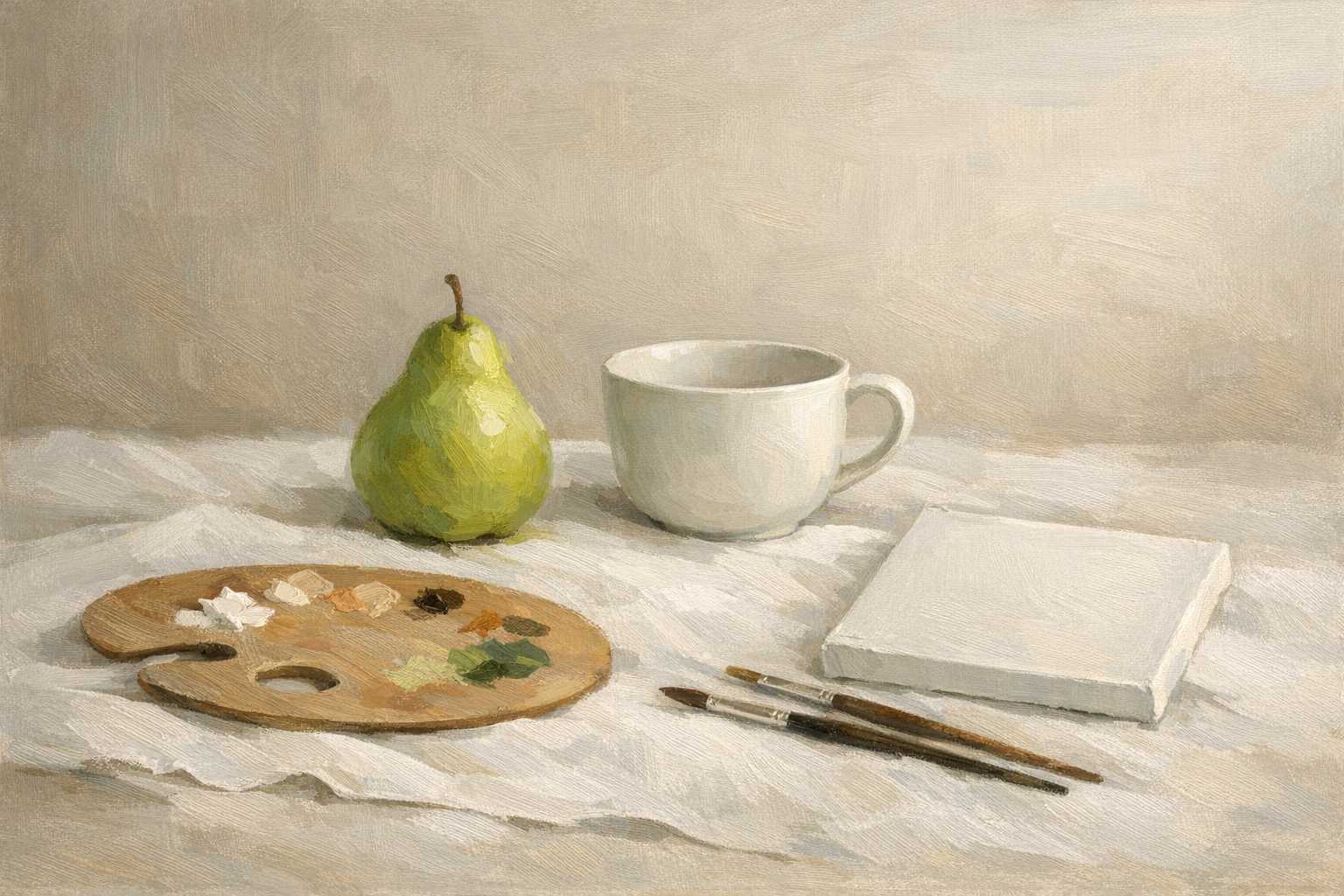
Tutorial: Minimalist Still Life, A Guide to Simple Object Painting
Artistic creation need not be complex. Minimalist still life painting emphasizes that simplicity holds its own unique elegance.
This guide will teach you how to paint ordinary items by employing graceful and minimalist brush strokes. We'll concentrate on formulating a balanced composition, selecting perfect color combinations, and improving the techniques for your artistic masterpiece to stand out.
Key Elements of an Outstanding Minimalist Still Life
The essence of minimalist still life painting is in the power of conveying more by displaying less, so it's not necessary to crowd your canvas with many elements.
Opt for one to three basic items, like a single apple, a porcelain cup, or a clear glass bottle. By painting them carefully, these commonplace items could be transformed into a masterpiece.
Unoccupied space, or negative space, around your main object is critical for this art form. This breathing space adds an aesthetic appeal that emphasizes your primary object.
Choose items with simple shape and clean lines. When you are starting out, avoid detailed or fancy items.
Selecting Your Objects and Their Arrangement
Start with items that have intriguing but simple shape. For instance, a pear's beautiful curves or how light and shadow play on a white egg.
Mount your chosen object against a unadorned backdrop. A white or neutral cloth serves this purpose well. Stray away from busy patterns which may distract the viewer from your main subject.
Lighting plays a critical role in minimalist still life painting. Use a solitary intense light source, directing it in a way that produces distinct shadows and highlights.
Natural window light usually has better results than artificial light as it provides a soft and uniform glow that allows for subtle color variations.
Fundamental Materials for Simple Object Painting
Expensive supplies don't guarantee a remarkable minimalist artwork. Initial materials will do just fine.
Regarding paints, a limited palette of white, black, and a color or two is sufficient. Such limitations challenge you to work on hues and composition.
Brushes, you only need two to three of varied sizes. A medium-sized flat brush for larger expanses and a small one for detailing are all you need.
Canvas boards or stretched canavas are ideal. Commence with smaller sizes like 8x10 inches to concentrate on the basics.
Step-by-Step Painting Procedure
Begin by making a light sketch. Determine the basic shape and position with a pencil while maintaining simple and neat lines.
Start by shaping out your main structures first leaving the minutiae for later and focus mainly on accurate proportions.
Begin from the darkest areas to establish your range of shading. Then move on to illuminate the brightest parts.
Proceed from a general perspective to a particular one. Start by painting the larger forms before delving into the small details. This strategy ensures your painting remains well-coordinated.
Don't rush to apply thick layers of paint, instead, build up your colors gradually as thinner layers are ideal for minimalist work.
Understanding Light and Shadow
In minimalist still life painting, light forms aspects of the object. Without correct light and shadow placement, objects may appear uninteresting and flat.
Observe how light affects your object. Pay attention to the most illuminated highlights and the dark places where the deepest shadows are cast.
The shadow side of your object should contain varying shades rather than one dark hue. Observe for reflected light and small color changes.
To make your objects look grounded and not floating, use cast shadows to anchor your objects to the surface.
When painting shadows, avoid using pure black. Mix colors corresponding to the object and the backdrop.
Color Mixing for Minimalist Paintings
A restricted color palette splendidly complements minimalist still life paintings. Three colors plus white can produce splendid results.
Instead of using tube grays, learn to mix them from your colors resulting in more harmonious paintings.
Varied temperature impacts add a level of sophistication without being complex. Cool shadows combined with warm lights lead to more realistic forms.
Investigate the actual colors of your subject. That "white" egg probably has a slight touch of yellow, blue, or pink in different locations.
Before applying the colors to your canvas, make sure to test and blend the colors on your palette. This ensures a clean painting and saves time.
Composition Techniques for Simple Still Life
To avoid a static and uninteresting look, place your main object slightly off-center.
Incorporate the rule of thirds. Divide your canvas into nine equal squares and position interesting aspects at the intersections of the lines.
Vary the dimensions of unoccupied space. This brings about an interesting visual appeal without adding more objects.
Consider the overall shape of your arrangement. Triangles and ovals often have better aesthetic appeal than squares or rectangles.
For a visually interesting image, keep some edges blunt and others sharp.
Common Pitfalls to Evade
Avoid overworking your painting. A minimalist artwork should look freshly done and instant. Overdoing ruins the simple and clean appeal.
Refrain from applying the same level of detail to every area. Certain regions should be more unfinished than others.
Don't be negligent of the background. It plays an equally significant role as your main object in this type of painting.
Fight off the urge to include unnecessary details. If it does not contribute to the composition, then omit it.
Hastening the observation stage is a no-no. Prior to starting your painting, spend ample time observing your subject.
Adding Final Touches and Final Analysis
Regularly take a step back from your painting. This provides a better overall view than a close-up, as it helps in identifying any discrepancies.
Test your tones by looking through half-closed eyes at your work. The distinction between the main shades of light and dark should be distinct and strong.
Analyze parts that feel unfinished or overdone and make adjustments cautiously.
Some edges should be nicely defined while others should be slightly articulated.
When satisfied with your work, sign it. Refrain from overworking an already well-working painting.
Practice Plans for Future
Start your practice by painting basic geometric forms like spheres or cubes to comprehend light and form without complex shapes.
Try to paint the same object under varying light conditions. Sunlight in the morning looks remarkably contrasted with the afternoon sun.
Undertake monochromatic painting experiments: Use one color plus white. This augments your perception of shades.
Transparent objects like glass bottles or wine glasses form great subjects since they present interesting challenges in reflections and refractions.
Creating a series of paintings showcasing the same object at different postures improves consistency.
Developing Your Minimalist Painting Style
Minimalist still life painting is about growth, not about reaching the end goal. Each painting provides new insights on perception and simplification.
Strive to focus on the essentials in every painting session. Identify the most important aspect of the object that you want to convey.
Work on developing your original style in terms of edges, colors, and brush strokes.
Study work by minimalist artists whose artwork you appreciate. Observe how they manage comparable subjects and obstacles.
Maintain regular practice. Consistently dedicating 30 minutes to painting can significantly enhance your skills and build confidence.
Remember, great minimalist work might look effortless, but it necessitates meticulous planning and expert execution. Keep it simple, be patient with your progress, and enjoy the pleasures of creating beautiful, clean artwork.