Atmospheric Perspective in Impressionist Landscape Painting
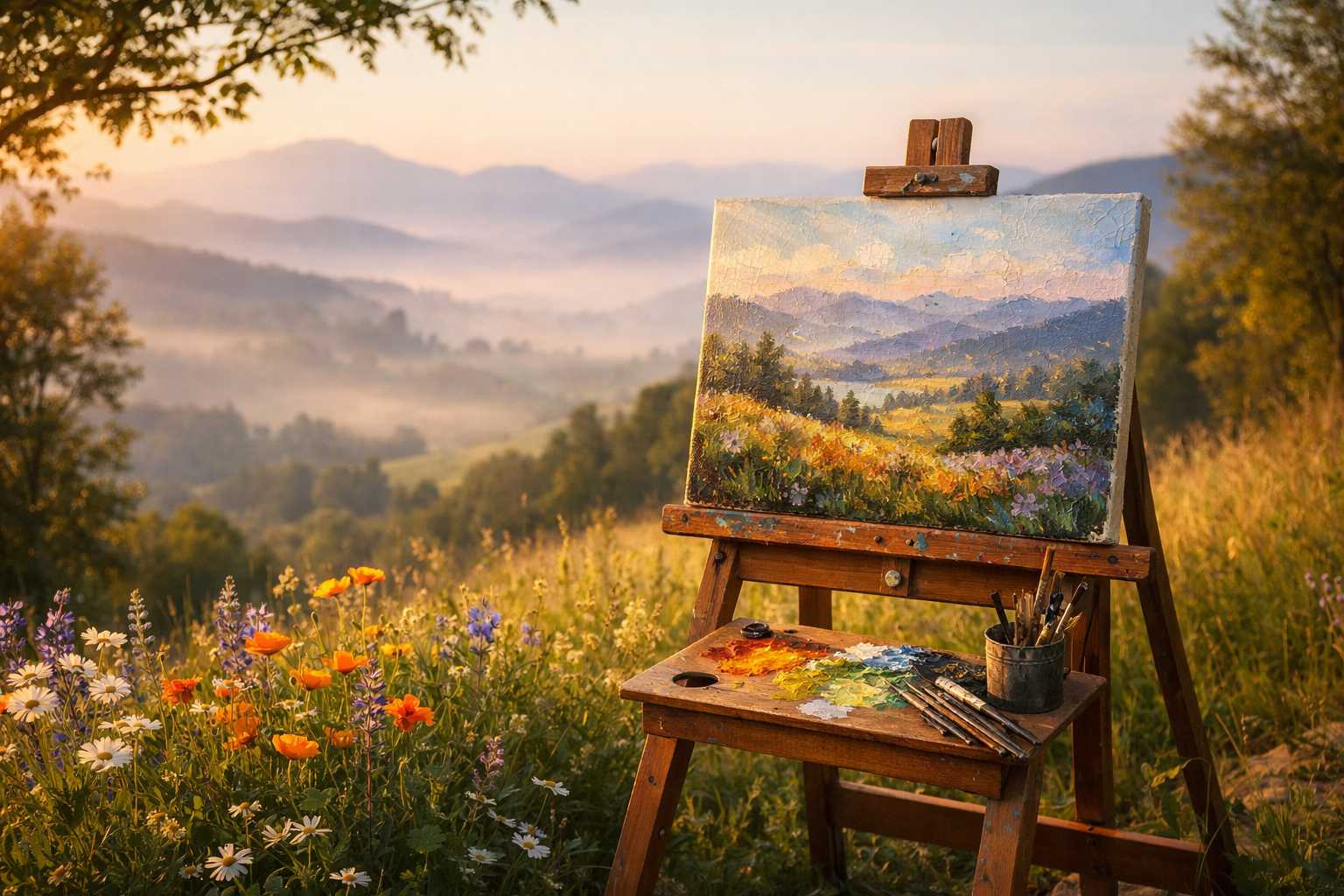
The Appeal of Atmospheric Perspective in Impressionist Landscape Art
Have you ever looked at a painting and felt as if it were almost breathing, brimming with the vitality of life? This captivating feeling often emerges from a technique called atmospheric perspective. This ingenious method transforms traditional, flat canvases into gateways to new dimensions.
Impressionist painters have mastered this approach in a way unlike any artists before them. They moved beyond simply depicting what was in front of them. Instead, they brought the very air they were breathing into their work, allowing it to influence how they perceived and imparted their subjects.
Defining Atmospheric Perspective
Atmospheric perspective is a technique that emulates how our eyes naturally perceive distance. Further objects tend to appear lighter, imbued with a blue tone, and less detailed. This effect arises because air particles diffuse light as it journeys towards us.
Consider gazing at mountains off in the distance. They appear slightly indistinct and tinged with blue-gray, correct? That's the magic of atmospheric perspective being demonstrated by nature itself.
Artists apply this concept to construct convincing depth on their canvases. They depict distant objects with cooler hues and blurring focus, while the items in the foreground remain sharp and enveloped in warmth.
The Impressionists' Innovative Approach to This Practice
Before the Impressionists’ era, artists primarily incorporated atmospheric perspective inside their studios. They abided by strict guidelines for how distant objects should be represented.
However, the Impressionists revolutionized this traditional approach. They seized their easels and took to the great outdoors, aiming to capture authentic light and ambiance.
The Practice of En Plein Air
"En plein air," a term meaning painting in the open air, was a groundbreaking concept in the 19th century. Most respected artists during this time worked indoors under artificial light.
Impressionists, however, unearthed a spectacular revelation upon stepping outdoors. The atmosphere wasn't a static blue-gray as suggested by older works of art. Instead, it was an ever-changing phenomenon, shifting with the weather, time of day, and the seasons.
Claude Monet, for instance, captured the same haystack in dozens of paintings, each image reflecting distinct atmospheric conditions. The morning haze, the vibrant afternoon sun, the descending shadows of the evening - all of these nuances were beautifully encapsulated in his work.
Disrupting the Color Norms
Whereas traditional artists would blend gray and blue for distant objects, the Impressionists saw a far more diverse palette.
They observed the many colors the atmosphere could assume, such as hues of purple, pink, orange, or yellow, fluctuating based on the light source and prevailing weather conditions.
This newfound perception led to their celebrated broken color technique. Instead of mixing colors on their palettes, they positioned untouched, vibrant colors side by side within their work, enabling your eyes to do the mixing upon observation.
Pioneering Practitioners of Atmospheric Perspective
Claude Monet: Ambassador of Atmosphere
Claude Monet had an unrelenting fixation on atmospheric effects. This is prominently showcased in his renowned series, Water Lilies, which vividly portrays atmospheric depth. The flowers appear as if they're suspended in a dreamy, mist-filled realm.
His series depicting the Rouen Cathedral is another exquisite example. Each canvas captures the cathedral under differing light conditions. It almost feels as if you can perceive the fluctuating atmosphere within the day.
Camille Pissarro: The Keen Observer
Camille Pissarro held a fondness for portraying rural landscapes. He emphasized how the ambiance impacts countryside views differently compared to city scenes.
His paintings of Pontoise reveal subtle atmospheric transitions - the morning fog, the clarity of midday, the evening haze - all rendered with detailed precision.
Pierre-Auguste Renoir: The Light Pursuer
Pierre-Auguste Renoir implemented atmospheric perspective in figure paintings. His outdoor portraits depict figures bathed in natural, ambient light.
The dappling sunlight in his work is palpable, even allowing you to sense the warmth of the air and the faint gusts of wind.
Essential Techniques for Achieving Atmospheric Perspective
Harnessing the Power of Color Temperature
Impressionists, with their intuitive understanding of warm and cool colors, skillfully pushed warm colors to the forefront while placing cool colors in the backdrop.
This careful manipulation created an impression of real depth without the need for harsh outlines, making objects appear as if they existed within a truthful, respiring space.
Mastering Soft Edges
Sharp edges suggest proximity, whereas soft, smudged edges indicate distance and ambiance. Impressionists adjusted their brush strokes as per this notion - foreground elements received precise, crisp strokes, while background areas were handled in a gentle, atmospheric manner.
Managing Value Relationships
"Value" is a term that refers to how light or dark an object appears. Impressionists discerned that the atmosphere tends to lighten the value of distant objects.
Painting objects farther away in a lighter shade than those closer created a convincing illusion of depth almost instantly.
The Continual Significance of this Technique
In contemporary times, artists continue to use the principles of atmospheric perspective across the spectrum of art forms. From digital artists, photographers, to traditional painters, all draw benefits from understanding these concepts.
Employing this technique allows artists to infuse emotion and mood into their work, with misty atmospheres conveying a feeling of mystery and romance, while clear, sharp atmospheres evoke a sense of energy and boldness.
Applications in Photography
Photographers naturally engage the atmospheric perspective, with conditions like the golden hour or fog enhancing the effect.
Grasping how the Impressionists perceived the atmosphere can assist photographers in composing impressive landscape shots.
Bridging the Digital Art Connection
Impressionist atmospheric techniques are thoroughly studied by video game artists and digital painters. Implementing these principles makes virtual worlds appear more authentic and immersive.
Lessons for Aspiring Artists
Looking to enhance your artistic insights? Consider learning from how the Impressionists approached atmospheric perspective.
If possible, visit museums and observe the impact of paint thickness and color choices on creating atmospheric effects. While online galleries also offer great learning resources, witnessing the original brushwork up-close carries a different charm altogether.
Try painting or photographing the same scene at varying times and note how the atmospheric conditions dramatically alter your subject's appearance.
Practical Exercises for Beginners
Consider starting with simple landscape sketches, focusing solely on the atmospheric effects instead of minute details.
Practice distinguishing distant objects by making them appear lighter and infused with cool tones, while the elements in the foreground remain warm and detailed.
During diverse weather conditions, capture photographs of the same view and compare the variations brought about by fog, rain, and the bright sunshine.
A Legacy That Endured
The Impressionists' mastery of atmospheric perspective irrevocably changed the path of artistry. They demonstrated that painting in nature could rival, if not surpass, the sophistication of studio work.
More than that, they unveiled new dimensions in the way we perceive our surroundings. Now, a foggy morning or a hazy afternoon transforms into a potential work of art.
Impressionist artists taught us to realize that the atmosphere isn't merely an empty space among objects. Instead, it's an integral, pulsating part of each landscape.
So next time when you gaze at a distant mountain or a horizon lined with trees, remember the teachings of the Impressionists. They showed us how the very air we breathe can compose a beautiful scene.
Their legacy thrives every time we appreciate the transforming effect of light and atmosphere on our everyday sights. And that's the true marvel of atmospheric perspective in the world of art.