Basic Brush Control: 7 Simple Exercises for Beginning Painters
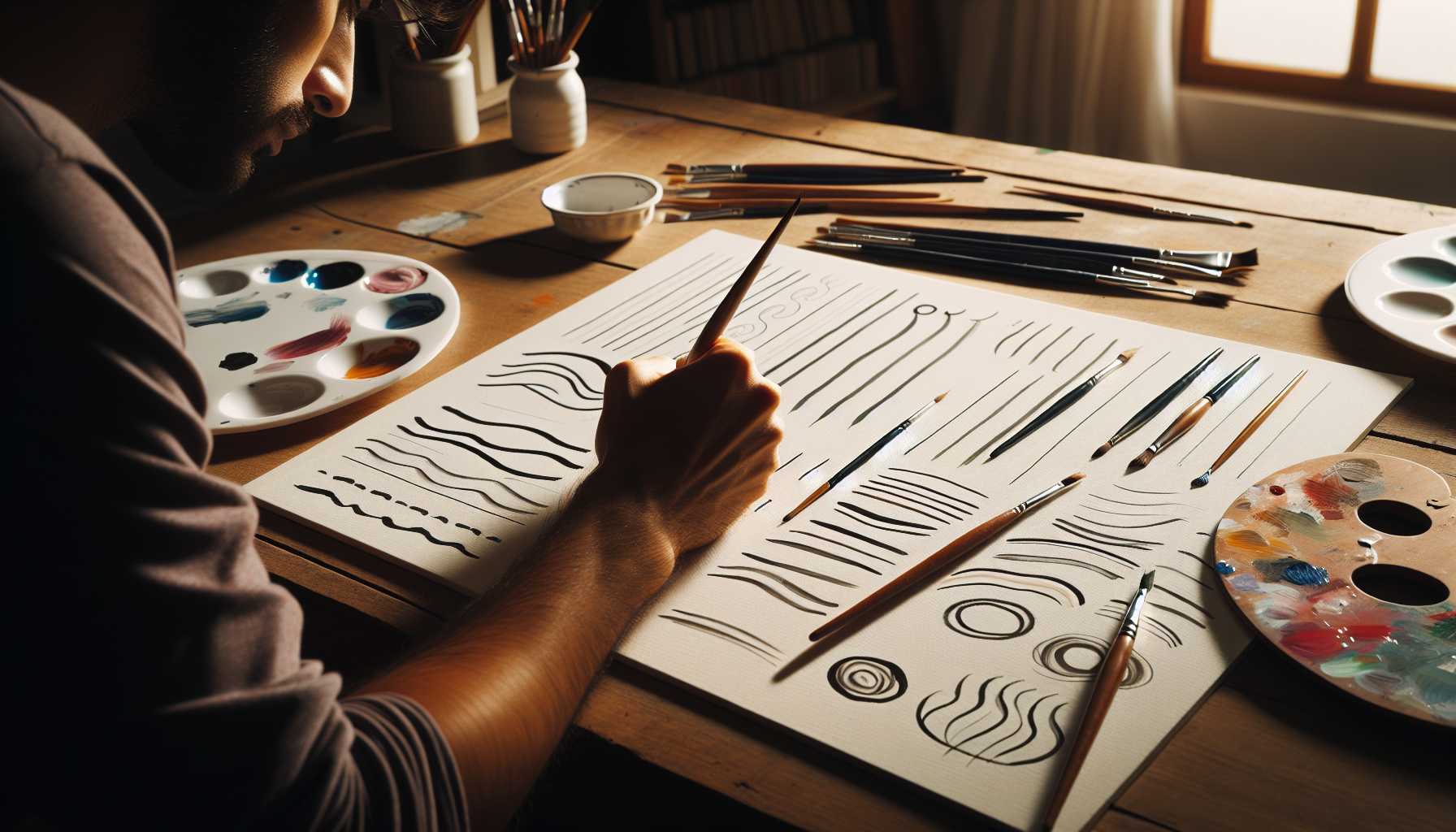
Building Basic Brush Skills: 7 Key Exercises for Aspiring Painters
Embarking on your painting odyssey can seem daunting. You are confronted by an untouched canvas with a brush in hand, pondering on where to commence.
The reality is, all renowned painters began at this exact point. Their journey started with baby steps - mastering the fundamental skill of basic brush control.
Consider brush control as your backbone. Without it, even the most vibrant of colors fail to bring your envisioned painting to life. However, with a few easy exercises, you will begin to feel confident with each brush stroke.
The Underrated Importance of Brush Control
Your brush acts as an added limb. With good control, you are able to shape precisely the marks you desire. Be it thick or thin lines, smooth curves or sharp corners - everything is achievable.
Poor brush control can lead to frustration. Your lines zigzag when you want them straight. Your detailing appears sloppy rather than pinpoint. But with continual practice, your brush becomes a finely tuned tool, reacting to your every touch.
Exercise 1: Execute the Straight Line
Beginning with a straightforward exercise. Apply straight lines across your canvas or paper.
Handle your brush at ease, not too firm. Kick off from one side and ease across to the other. Don't fret if your initial lines seem jittery - that's completely typical.
Experiment with pressures. Apply force for thicker lines. For thinner ones, use a gentle touch. Pay attention to how the brush reciprocates to your movements.
Incorporate this exercise into a daily five-minute routine. You'll swiftly notice your lines steadying.
Exercise 2: Master Your Curves and Circles
Gradually add some dynamism into your practice. Sketch large, silken circles on your canvas.
Take your time. Concentrate on maintaining fluid and uninterrupted motion. Your circles don't need absolute perfection - aim for smoothness and confidence.
Transition to figure-eights. This helps boost your control in both directions — essential for successful painting. It's analogous to driving a car—acquiring comfort in turning both left and right is crucial.
Rotate your circle sizes. Shift between large and small circles. Each size demands distinct muscle control.
Exercise 3: Forging Consistent Parallel Lines
This practice enhances precision and pacing skills. Draw a series of parallel lines, consistently spaced apart.
Utilize your whole arm, not just your wrist. It offers improved control and prevents hand fatigue. Maintain even spacing by using your eyes as a measuring tool.
Begin with vertical lines, then horizontal. Diagonal lines pose more of a challenge, so reserve these until you're feeling assured.
This exercise emulates techniques applied in actual painting scenarios, like creating textures in grass or wood grains.
Exercise 4: Pressure Control Practice using Gradients
Douse your brush with paint and create smooth transitions from thick to thin lines. Kick off with dense pressure, then progressively lighten your touch.
This teaches you how pressure dictates your brushstrokes. Forceful pressure yields bold, compelling marks. Delicate pressure forms refined, understated lines.
Reverse the sequence too - initiate with lightness and step up pressure gradually. Both procedures are valuable in real-life painting circumstances.
You'll apply these techniques when painting diverse elements, from flower petals to mountainous landscapes.
Exercise 5: Accelerate Your Pace with Swift Strokes
It's time to step up the speed. Create swift, assured strokes across your canvas.
The goal is not perfection, but rather confidence. Quick strokes help you to trust your instincts while also instilling energy and dynamism into your paintings.
Experiment with different directions: vertical, horizontal, diagonal. Integrate curved strokes with straight ones.
Ease your thoughts and let your hand glide naturally. You're cultivating muscle memory that serves you well in future paintings.
Exercise 6: Crafting Rhythm with Recurring Patterns
Develop straightforward patterns using consistent brush strokes. Experiment with lines of dots, dashes or small curves.
This practice is akin to meditation. You'll discover a natural rhythm as you work. This rhythm contributes to smoother, more confident future paintings.
Ensure your pattern size and spacing remain constant. This develops the control required for detailed work, such as painting leaves on a tree or scales on a fish.
Alter your patterns to keep the exercise interesting. Zigzags, waves, or crosshatches all serve to this purpose.
Exercise 7: Synthesize All Skills in Free-Form Practice
Now is the time to merge all your acquired skills. Construct abstract compositions utilizing all the techniques you’ve practiced.
Combine straight lines with curves. Intermingle thick strokes with thin ones. Experiment with your pressure and velocity.
Don't strive to paint anything specific. Simply concentrate on making assured, controlled marks. Allow your brush to waltz across the canvas.
This is the stage where the true magic unfolds. You'll begin to feel the brush working in harmony with your intentions. Your confidence will escalate with every passing stroke.
Formulating Daily Practice as a Habit
The hidden secret segregating good painters from exceptional ones: regularity trumps intensity.
Quarter of an hour of daily practice will accelerate your skills quicker than three hours once a week. Your muscle memory strengthens through repetition, not through lengthy sessions.
Dedicate a modest practice area for these exercises. Keep it uncomplicated - a full studio setup isn’t necessary.
Track your development by dating your practice sheets. You'll be amazed at the rapid progress made within a couple of weeks.
Common Pitfalls to Steer Clear From
Avoid clutching your brush too tightly. A relaxed grip offers superior control and helps prevent hand cramps.
Resist the urge to rush through exercises. Speed naturally follows practice. Prioritize control first.
Don’t avoid the "mundane" exercises. Those straight lines and circles are the stepping stones for all your future paintings.
Ensure to clean your brush between exercises, especially when changing colors. A dirty brush hampers control significantly.
Forging Your Path Ahead
These seven exercises construct the base of sound brush control. Master them and face every painting task confidently.
Initiate just two or three exercises per practice session. As they become less challenging, introduce the others.
Always remember, every professional painter began grappling with basic brush control. They prospered through continual practice, patience, and determination. You will too.
Your brushstrokes will emerge as an expression of your artistic voice. With these exercises as your roadmap, that voice will strengthen and exude confidence with each passing day of practice.
So now, pick up that brush and dive into your first exercise. Your painting journey unfolds with a single, solid stroke.