Quick Canvas Art: 20-Minute Painting Projects for Beginners
Simple Canvas Art: 20-Minute Painting Projects for Beginners
Have you ever yearned to create beautiful artwork but felt restrained by time? Dispense with that notion immediately! You are fully capable of crafting stunning canvas art in merely 20 minutes.
You may be skeptical, wondering, "How could I produce something remarkable in so little time?" I once stood in your shoes, questioning my abilities. However, I discovered that many of the most alluring works of art are ones that can be created quickly and simply. So let's dive into these user-friendly projects that will not only bolster your confidence, but also infuse your walls with vibrant colors.
Why You Should Dive into 20-Minute Art Projects
Our lives often get engulfed by work, family, and everyday chores, making it seem like dedicating time to art is a mere fantasy. However, quick canvas art projects tackle this issue effectively. They effortlessly blend into your routine - you can paint during lunch breaks, while waiting for dinner to cook, or even right before bed.
Moreover, these swift projects lift pressure off your shoulders. There's no space to overanalyze or strive for unrealistic perfection. Instead, the focus is solely on painting and savoring the process.
Additionally, you get to witness your results instantly. Standing back to admire your creation, knowing 'I made that', is a feeling unlike any other.
The Basics for Quick Canvas Art
You need not break the bank to get started on your art adventure. Here is my basic manual:
Canvas: - Pre-stretched canvases (sizes like 8x10 or 9x12 inches are typically suitable) - Canvas boards for practicing
Paints: - Acrylic paints in fundamental colors - White for mixing and creating highlights - A couple tubes of paint are sufficient
Brushes: - One flat brush (1-inch wide) - One round brush (Size 6) - One small detail brush
Additional Items: - Paper towels or cloth rags - Water container - A palette or a humble paper plate
Remember, you can create masterpieces without the 'perfect' setup. In fact, I painted my first work of art using a paper plate!
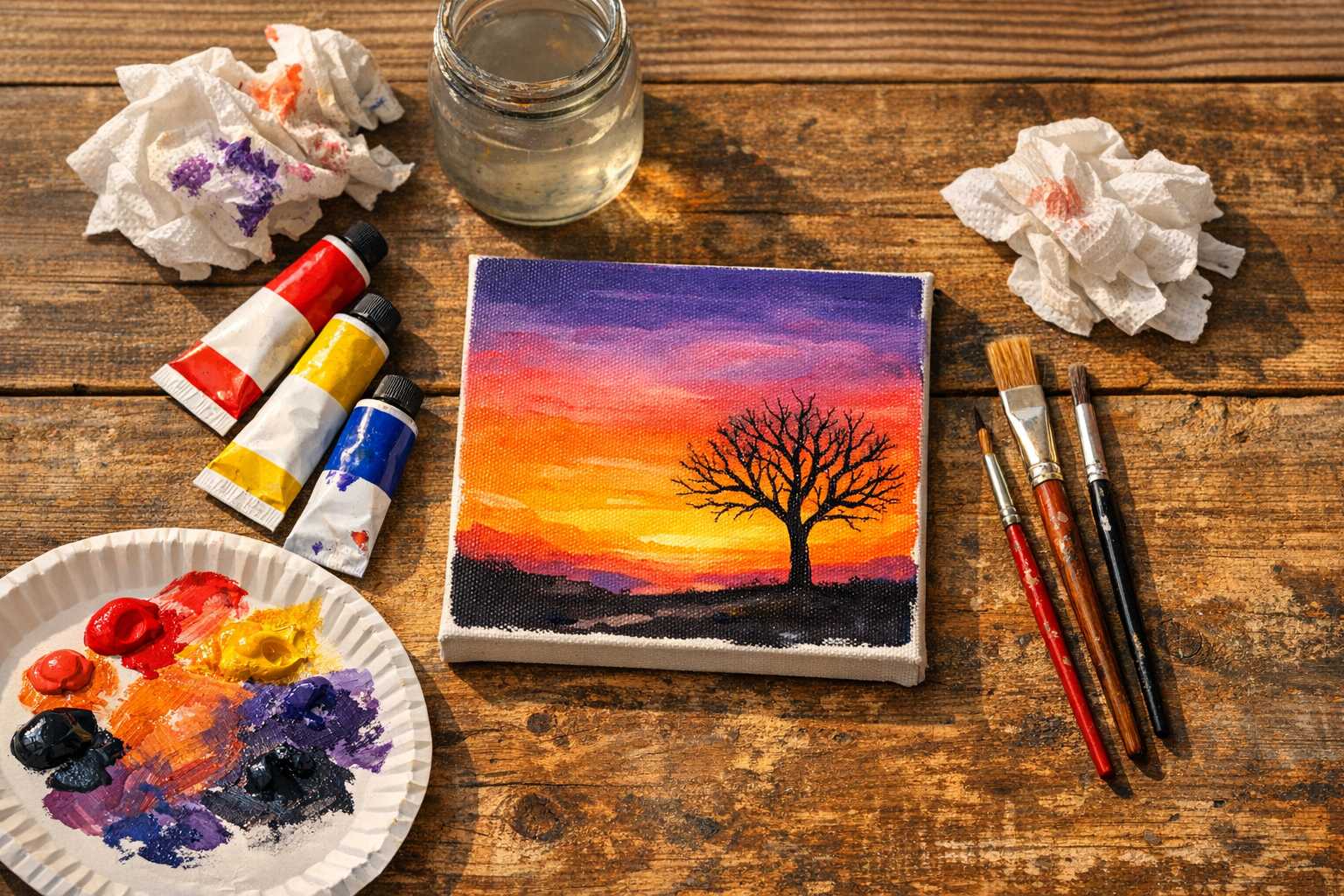
Project 1: Silhouette at Sunset
This project is designed for maximum effect with minimum effort.
Commence with a horizontal canvas. Color the top half with dark blue or purple and gradually blend down to orange, leading to yellow at the bottom.
Make sure to work swiftly while the paint is still wet. Perfection in blending isn't necessary - rough transitions often appear more authentic.
Once the painting dries, imprint a simple silhouette - perhaps a tree, a chain of mountains, or a city skyline, using pure black paint. Stick to bold and straightforward shapes.
The stark contrast between the vivid sunset hues and the dark silhouette brings forth a stunning visual impact.
Project 2: Blocks of Abstract Colors
Though abstract art may seem daunting, it is actually the most forgiving style, especially for novices.
Select three colors that resonate with you. Construct large, overlapping rectangles across your canvas, allowing the colors to merge at their junctures.
Pepper in some white or a lighter hue to create highlights. Employ your brush to introduce texture by either dabbing or executing short strokes.
Frequently step back to see how your artwork looks from a distance. Trust your instincts to inform you when to put down your brushes.
Project 3: Simplified Landscape
Landscapes may appear complex, but creating their simplified versions is remarkably quick.
Break your canvas into three horizontal segments. The top third should be painted with light blue to represent the sky. The middle segment denotes distant hills with a muted color. The bottom third stands for the foreground.
Introduce simple elements like clouds, basic tree shapes, or perhaps a winding path. Use darker colors to paint the foreground and lighter tints for the backdrop.
This process generates natural depth without employing intricate techniques.
Project 4: Minimalist Floral
Floral elements don’t necessarily have to be meticulously detailed to be beautiful.
Choose a single color for the flowers and create simple petal shapes. Envision basic oval or teardrop shapes gathered in circular clusters.
Construct stems using quick downward brushstrokes in green and shape a few leaves as uncomplicated ovals.
Maintain simplicity for the background, possibly a soft blue or cream. The clear distinction will make your flowers stand out remarkably.
Project 5: Stylized Ocean Waves
Depicting water may seem challenging, but creating artistic waves is surprisingly easy.
Begin with a blue-green base spread across your canvas. While still wet, introduce white paint, creating horizontal wavy patterns.
Use a dry brush to blend some areas softly, leaving other zones more defined, creating contrast.
Finish off by adding froth and spray, using tiny dabs of white paint. The key is not to overthink the movement of water while painting.
Project 6: Enchanting Night Sky
Dark backgrounds help conceal any small imperfections and instantaneously create a captivating atmosphere.
Paint your entire canvas either dark blue or black. Then, while it's still wet, add a few touches of purple or deep green hues.
Upon drying, use white paint to sprinkle stars of varying sizes. Some can be minute specks, while others slightly larger for balance.
For an extra enchanted effect, incorporate a simple moon shape in light yellow or white. Blend the moon's edges gently into the sky.
Tips for Scoring with Speedy Painting
Whenever feasible, practice wet-on-wet painting. This aids in blending as paint remains workable for a longer duration.
Choose larger brushes than you believe you need. They cover a wider area swiftly and restrain you from overworking minute details.
Regularly take a step back. Your concoction of colors will appear differently when viewed from afar.
Embrace happy accidents. That "blunder" might exactly be what your canvas needed.
Set a timer. This helps to concentrate and deters overthinking.
Beginner Pitfalls to Dodge
Be mindful not to overly dilute acrylic paints with water. They should feel rich and creamy, not watery.
Refrain from using small, detailed brushes for these quick projects. They mitigate your speed and induce overworking.
Avoid being overly critical of your work. Everyone starts somewhere, including famous artists. Remember, even Picasso had to learn how to wield a brush!
Resist the urge to "fix" everything. At times, flaws can impart character and charm.
Nurturing Your Confidence with Swift Victories
Each 20-minute painting session contributes to honing your skills and boosting your confidence. You get to learn color mixing, brush control, and composition without the stress of committing a substantial amount of time.
You might wish to paint the same theme multiple times with varying color patterns. You'll be astonished at how much progress you make with each try.
Always keep your completed pieces in plain sight. They serve as a reminder of your burgeoning abilities and provide inspiration for your next creative sessions.
Turning It into a Habit
Regular practice trumps sporadic bouts of perfection. It’s far better to paint regularly for 20 minutes than wait aimlessly for the elusive four-hour window.
Establish a small art corner that's always prepared. Hence, whenever creativity hits, you can set to work immediately.
Treat your painting time as a personal meditation. Painting requires your undivided attention, which inadvertently calms your wandering mind and helps alleviate stress.
Embark on Your Creative Journey Now
You have all the tools required to create attractive canvas art in just 20 minutes. The resources are simple, the techniques are beginner-friendly, and the gratification is instantaneous.
Remind yourself that every professional artist initiated their journey with a simple stroke of a brush — no one expects your stroke to be flawless. Most importantly, it needs to be yours.
So pick up that brush, squeeze some paint, and indulge in 20 minutes of uninhibited creativity. Your future painting-savvy self will thank you for starting today.
The canvas is beckoning. What will be your masterpiece?